6 Stages of Ecommerce Website Development Process at Tonjoo
Published on
WooCommerce is a WordPress-based platform designed specifically for e-commerce websites. Being built on WordPress, WooCommerce offers exceptional flexibility, an extensive plugin ecosystem, and robust SEO optimization support, making it easier for online stores to be discovered on search engines.
At Tonjoo, we believe a well-defined strategy is the cornerstone of a high-quality online store. To achieve this, our development process is systematically executed through a series of structured stages, starting from planning and design, through development and testing, and concluding with post-launch maintenance.
This article will detail the entire process of building a professional online store at Tonjoo, from the initial consultation session to the support services provided after your store goes live.
Table of Contents
The Ecommerce Website Development Process at Tonjoo

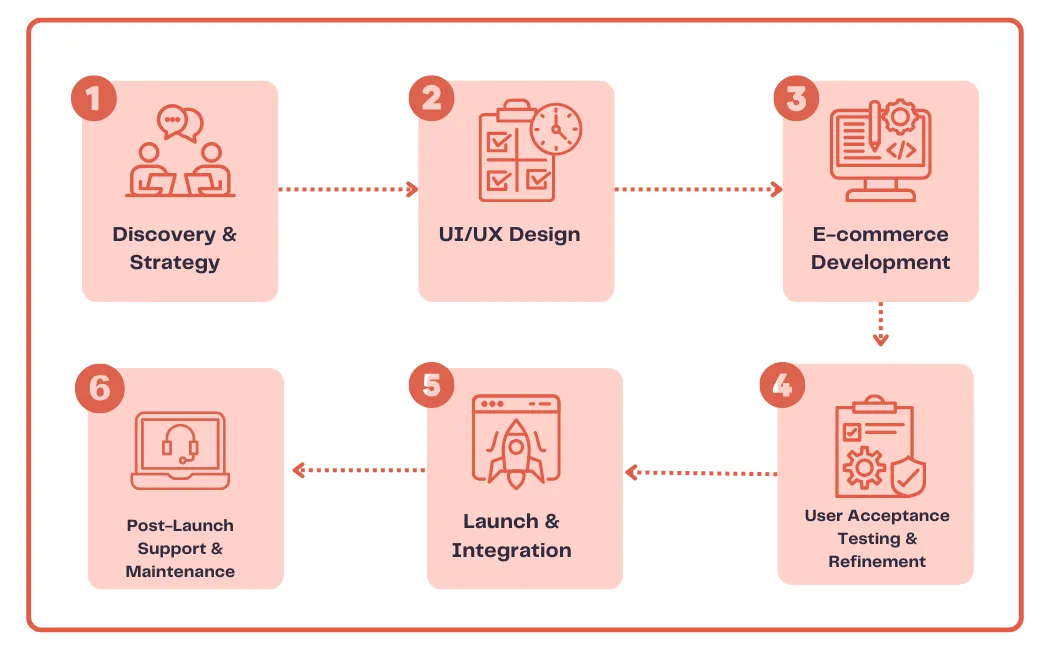
Diagram of the online store development process
To ensure the success of our clients’ online stores, we at Tonjoo begin every project with a solid strategy. We divide the process into six main stages, where each step, from planning to launch, is executed with optimal care. The goal is simple: to deliver the best possible outcome that aligns with the client’s business needs.
Tonjoo has extensive experience in developing online stores using WooCommerce. WooCommerce is a feature-rich e-commerce platform that allows you to manage products, variations, coupons, shipping, and payments all in one place.
The WordPress ecosystem that underpins WooCommerce also supports SEO optimization. An SEO-friendly online store is crucial for getting indexed and discovered on search engines.
For clients seeking superior performance, a headless architecture is an option. With this approach, Tonjoo uses WordPress with WooCommerce as the back-end, which provides data through an API. The front-end is then built using React JS. The result is a highly responsive, fast, and scalable online store.
1. Discovery & Strategy
The Discovery & Strategy phase, which involves consultation and planning, is the first step in creating an online store. This stage is critical as it forms the foundation for the entire development process. Here, Tonjoo helps clients explore their needs, understand their business objectives, and define the right strategy before moving on to the design and development phases.
Based on these strategic discussions, we recommend a technical framework that aligns with business goals, especially for online stores that require a comprehensive platform for product management.
With meticulous planning, the online store will not only be visually appealing but also commercially effective, SEO-friendly, and relevant to the target market’s needs.
The steps in this stage are:
- Initial Contact: The process begins when a prospective client contacts Tonjoo through any of our available communication channels, whether via WhatsApp, email, or by visiting our office directly.
- Initial Analysis: If the client already has an online store, the Tonjoo team will conduct an initial analysis to identify areas for improvement. We use professional tools like GTmetrix, Ubersuggest, and PageSpeed Insights, as website speed is a critical ranking factor and significantly impacts user experience.
- Requirement Gathering: This is the stage where we schedule a meeting to delve into the client’s needs. In this session, we discuss crucial aspects of the online store, such as the target market, product categories, payment methods, shipping options, checkout flow, promotions, ERP integration, and refund policies.
- Information Architecture Design: Based on our discussions, our team will compile a user story document, sitemap, and wireframes that emphasize the conversion flow. The conversion flow for an online store typically includes listing → cart → checkout.
- Initial Design Options: To provide a visual preview, Tonjoo prepares two design options for the e-commerce homepage, complete with design rationales. This allows the client to choose the visual approach that best suits their brand identity.
- Project Proposal: Once all planning is complete, the results are summarized in a final project proposal that includes the scope of work, a detailed cost breakdown, and a project timeline.
Once the initial concept is agreed upon, the creative process begins. The next stage involves transforming the strategic blueprint into a complete visual design.
2. UI/UX Design
After the strategy and foundational framework are established, Tonjoo translates the plan into a professional design that aligns with the client’s brand identity. At this stage, our focus is not just on aesthetics but also on user experience and the store’s functionality, ensuring visitors have the best possible shopping experience.
The detailed steps in this stage are:
- Kick-off Meeting: Once the proposal is approved and the contract is signed, Tonjoo holds a kick-off meeting to align the vision and expectations between our team and the client.
- Mockup Creation: Our design team begins creating comprehensive design mockups for both desktop and mobile versions, covering the homepage, category pages, product detail pages, cart, checkout, and customer accounts. These are based on the meeting outcomes and approved wireframes. The approved mockups serve as a visual guide for the development team.
- Feedback & Revisions: The initial design version is presented to the client for feedback. The revision process is collaborative, continuing until the design reaches a satisfactory final result.
Once the final design is approved, the high-resolution mockup files are handed over to Tonjoo’s development team to begin the e-commerce development phase.
3. E-Commerce Development
In the e-commerce development phase, the visual design is transformed into a fully functional online store. This process is handled by a professional development team consisting of Front-End Developers, Back-End Developers, and Quality Assurance (QA) specialists.
The steps in this stage include:
- Front-End Development: The front-end team focuses on translating the visual design from Figma into WooCommerce. The approach chosen depends on the project’s complexity. For simple online stores, using a WordPress theme with the Site Editor is sufficient, allowing for quick and easy content editing. For greater complexity, a custom WooCommerce theme is the preferred choice, offering more precise control over design, structure, and performance. For highly complex online stores demanding top performance, a headless architecture is the solution, where WooCommerce acts as a CMS/API (back-end) paired with React JS on the front-end.
- Back-End Development: The back-end developer’s tasks include configuring WooCommerce, setting up the database, and creating custom plugins. Essential plugins for an online store include a Shipping Cost Calculator, Payment Confirmation, Refund Plugin, Payment Reminder, and Shipping Receipt Sender. The back-end team also configures coupons, loyalty programs, payment gateway integrations, courier integrations, and third-party APIs. In a headless scenario, WooCommerce functions as a content management system API.
- Quality Assurance (QA): Before client testing, our Quality Assurance (QA) team conducts a series of internal tests. The QA team evaluates the online store from an end-user perspective, ensuring all ecommerce website features function correctly across various devices. This includes testing the product catalog, cart, checkout, payment processing, email notifications, and shipping/tax calculations. They also test for speed and cross-platform compatibility. This stage guarantees that the online store delivered to the client is stable and ready for further testing.
After all development processes, front-end, back-end, and Quality Assurance, are completed, the next phase is testing the online store with the client.
4. User Acceptance Test (UAT) & Refinement
Before launching to the public, Tonjoo conducts final testing and refinement through User Acceptance Testing (UAT). The UAT stage is when the client can verify that every feature works perfectly. This phase is done collaboratively, allowing the client to review the online store’s performance, functionality, and appearance to ensure it is ready for optimal operation upon going live.
The steps in this stage include:
- User Acceptance Test (UAT): We invite the client to conduct tests together on a staging server. This testing covers processes like product search, adding items to the cart, checkout, payment, notifications, and order status updates. The goal is to ensure all features function according to the client’s needs and expectations.
- Bug Fixing & Revisions: Based on the test results and feedback from the client during UAT, the Tonjoo team will promptly perform bug fixes, content adjustments, speed optimizations, SEO settings, and user interface refinements for the checkout process.
Once all testing and final refinements receive the client’s approval, the online store is ready to go live.
5. Launch & Integration
The launch phase is a pivotal moment when the online store is officially activated and made accessible to the public. Tonjoo ensures a seamless transition from the staging server to the live server and that all technical elements, such as analytics and security, are properly integrated.
The steps in this stage include:
- Deployment: Tonjoo’s deployment process utilizes Docker to ensure a smooth transition when moving the online store from the staging server to the live server. This makes the store publicly accessible.
- Technical Configuration: The Tonjoo team ensures that the domain, hosting, analytics systems (like Google Tag Manager and GA4), SSL certificate, and CDN (Content Delivery Network) are all correctly installed and functioning optimally to monitor the store’s performance. An SSL certificate is essential for building trust and securing transactions, while a CDN ensures fast loading times for users accessing the site from anywhere in the world.
- Final Check: After going live, the Tonjoo team performs a final check to ensure no errors appear when the online store is accessed by the public. This verification includes checking the order flow, payments, emails, stock management, and page performance.
- Optimization: The Tonjoo team also performs SEO, PageSpeed, and security optimizations to ensure the online store has strong performance and visibility on search engines right from day one.
After all these processes are complete, the client’s online store is live and ready for public access with fast performance, a solid security system, and optimizations poised to support business growth.
6. Post-Launch Support & Maintenance
Tonjoo’s support doesn’t end after the e-commerce website is launched. We understand that an online store needs to evolve over time. Therefore, Tonjoo provides post-launch support services to ensure the client’s store remains secure, fast, and aligned with business growth.
The steps in this stage include:
- Routine Maintenance: This service covers regular system updates, such as plugin and theme updates, scheduled backups, server monitoring, and security audits. Outdated systems and software are the number one security vulnerability exploited by hackers. Additionally, maintenance services include periodic performance checks.
- User Training: Tonjoo provides training sessions for the client’s team so they can manage the online store independently. In these sessions, the team will learn how to manage products, stock, orders, promotions, and sales reports.
- Ongoing Technical Support: The Tonjoo team is ready to assist if the client encounters technical issues or has requests for additional feature development in the future. Our team can also help with system integrations and provide guidance for business growth.
Overall, these six stages of the online store development process are our commitment to ensuring that a store built by Tonjoo not only functions well but also aligns with the client’s business objectives.
Estimated Timeline for Online Store Development

The time required to build an online store varies greatly depending on the complexity of features, design, and project scale. Here is a general estimate based on Tonjoo’s experience:
- Low Complexity: For a simple online store with a basic product catalog, development usually takes about 1.5 months.
- Medium Complexity: For an online store with more advanced features like product variations, multi-courier options, and promotions, the development time is around 2.5 months.
- High Complexity: For an online store requiring Enterprise Resource Planning (ERP) or Order Management System (OMS) integration, multi-warehouse support, or a headless architecture with complex API integrations, the development time can be 3 months or more.
Build Your Dream Online Store with Tonjoo
That concludes the overview of Tonjoo’s online store development stages. Our process is designed to deliver maximum, measurable results. With a systematic approach, a team of professional experts, and a choice of technologies like WooCommerce, React JS, and Docker, we are ready to help you build an online store that serves not just as a digital storefront but as a reliable sales engine.
Entrust your e-commerce development and optimization to Tonjoo’s Online Store Development Services. We have served hundreds of clients, including Aqua, Polygon Bikes, and many others. You can choose a practical WooCommerce-based store or a headless architecture combining WooCommerce and React JS, with flexible deployment options, on the cloud, VPS, Docker, or your own server. We are ready to make it happen.
Are you ready to get started? Contact us now for a free consultation, a price quote, and a timeline estimate tailored to your needs.


FAQ: The Online Store Development Process at Tonjoo
1. What platform do you use to build online stores?
We build online stores using WooCommerce, an e-commerce platform based on WordPress. The main reason is that WooCommerce offers high flexibility, a rich plugin ecosystem, and excellent SEO optimization support, making it easier for online stores to be found on search engines.
2. What are the main stages in the online store development process?
There are 6 main stages:
- Strategy: Initial planning based on your business goals.
- UI/UX Design: Creating a visual design (mockup) for your approval.
- Development: Turning the design into a functional online store.
- UAT (Testing): You get to test all features before the launch.
- Launch: Activating the online store to make it publicly accessible.
- Support: Post-launch maintenance, training, and technical assistance.
3. What is “headless e-commerce”?
It’s an advanced architecture where the front-end (what users see) and the back-end (data management system) are separated. The goal is to achieve an ultra-fast and responsive online store performance.
4. Can I test the online store before it goes live?
Absolutely. Through the User Acceptance Test (UAT) stage, you will test all features on a staging server to ensure everything works as expected.
5. Is there support after the online store is completed?
Yes. We provide post-launch support services that include routine maintenance (updates, security), training for your team, and ongoing technical support.
6. How long does it take to build?
The estimated time depends on the complexity:
- Low: ~1.5 months
- Medium: ~2.5 months
- High/Complex: 3 months or more
Read similar articles by Moch. Nasikhun Amin on the Tonjoo blog about WordPress, WooCommerce, plugins, and other web development topics.
Updated on January 26, 2026 by Moch. Nasikhun Amin